
It started with a simple question.
In 2023, the state of Michigan took steps to address low adult literacy rates by administering grants through the Michigan Association of Community and Adult Education (MACAE).
At the time, adult education services in Northeast Michigan were hard to come by.
The Regional Educational Service Agency (RESA) in Iosco County, which provides education services across eight counties, offered career and technical education, special education, and corrections education—but the only adult education opportunities were up north at the literacy center in Alpena County.
Iosco RESA Executive Director Whitney Dettmer questioned why they did not have more widespread literacy support across their region, which is the size of the state of Massachusetts.
“It always stuck with me, because this is such a great resource that we have in one of our eight counties. Wouldn’t it be amazing if we had it everywhere else?” she said.
She asked the superintendent why there were no other adult literacy centers. His reply: “Start one.”
Challenge Accepted
 Iosco RESA applied for the state grant for adult education, and they went big, Whitney said. They learned they had received a significant amount of funding to bring adult education to Northeast Michigan, and Whitney would need some help.
In early 2025, the team hired a marketing specialist, a literacy specialist, and two retention specialists. Together, they set out to build a literacy program from the ground up, and Iosco RESA rebranded and became Northeast Michigan Adult Education.
ProLiteracy Becomes the Blueprint
Jenny Luzar joined the effort as the literacy specialist. Although she brought 30 years of teaching experience across high school and college settings, she quickly realized that building a literacy program required a different kind of expertise.
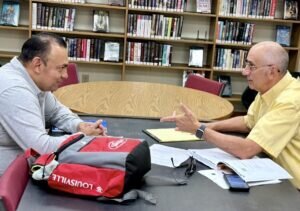
“It was this challenge of, oh, how do I teach the fundamentals of reading? And you’d think you’d know how to do that, but guess what? You don’t,” Jenny said. “You can have as many degrees as you want and have taught thousands of students, but if you haven’t needed [to teach people to read], you don’t realize … I don’t know how to do this.”
But an unexpected resource came from her mother, who had been a literacy teacher in the 1980s and ‘90s. She pulled out a copy of LitStart and suggested Jenny explore an organization called ProLiteracy.
Jenny dove into LitStart, which she knew the Alpena program used as well. She was immediately captivated. It became the backbone of everything she would build. It didn’t matter how savvy someone was with technology or what their skill sets were; Jenny recognized she could use it with volunteers in the community as the perfect introduction to teaching adults.
From there, she began to explore the ProLiteracy website, accessing resources using their ProLiteracy membership, which they had through MACAE. Everything the new program needed, Jenny realized, was right there ready to go from ProLiteracy.
“I was absolutely floored by the materials that were there. There was no reason to recreate the wheel; everything had been done for me.”
She went through our Tutor Training herself and then began leading new volunteers through the training.
She signed up for ProLiteracy newsletters and webinar updates via email.
“By the stars aligning, it always happens to include the webinar I need to see or participate in that week.”
She talked to her friends at the Alpena adult education program who recommended their favorite New Readers Press instructional materials:
- Challenger
- Journey to Success
- Laubach Way to Reading
She used ProLiteracy’s infographics and charts with community partners.
“They are really classy looking, not cheesy, not created by AI, they have the right amount of intellect but are not scary. I can take them into the community to share facts about adult literacy from a national organization. It’s amazing not to have to create these things on my own, and it gives me credibility.”
Instead of building every process, lesson, and training from scratch, the team used ProLiteracy resources, professional development, and instructional materials as their blueprint. Having trusted resources allowed Jenny to spend more time promoting the program, recruiting volunteers, and meeting with potential partners—always with a copy of LitStart under her arm to show people what they are doing.
From Launch to Local Impact
The results came quickly. Within just three months, they created Northeast Michigan Adult Education, launched services, and trained tutors all powered by ProLiteracy resources.
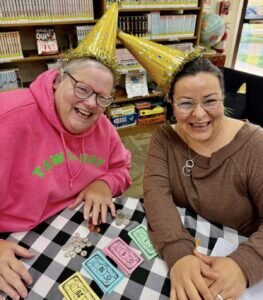
Today, the program is being piloted in Iosco County, with the flexibility to identify and train tutors in neighboring counties as needs arise. There are currently 15 one-to-one student-tutor partnerships, along with an ESL conversation program hosted at a local coffee shop.
Using strategies presented in ProLiteracy resources, Jenny said she has seen students make gains that have led to increased confidence and self-actualization.
- Using pictures with words in a comic strip application, a 65-year-old woman can now understand the Bible passages she’s read her whole life but struggled to comprehend.
- An 85-year-old man who read at a second-grade level wanted to write his life story. He tells his story through talk to text, which his tutor prints out to use as his reading material at their next session.
And this is only the beginning. Every student is a success, Jenny said. Based on the program’s first-year, the team plans to expand in the coming year.
“There is no way I would have accomplished in the last year what I did had the resources from ProLiteracy not been available,” she said. “The minute Whitney introduced me to ProLiteracy, I was able to breathe again.”
Browse our full collection of courses and resources.