
The CASAS® assessments are historically known for their focus on ensuring adults have the skills to navigate and succeed in the real world. In addition to aligning academic skills to the College and Career Readiness Standards (CCRS) for Adult Education, the content also must integrate with the CASAS Competencies of over 360 essential life and work skills that adults and youth need to function effectively in their communities, families, and workplaces.
Recently, the testing company implemented some updates to its NRS-approved Reading and Math GOALS series to better reflect the needs of today’s adult learners. The new assessments—CASAS GOALS 2—were formally put into use as of July 31, 2026. As states and programs switch to the GOALS 2 series for reporting purposes, we thought it might be useful to connect with CASAS on the updates to find out exactly what is new and how the updates were designed to help adult learners.
A Q&A with CASAS
Below is our Q&A with CASAS Assessment Development Director Daniel Esko.
ProLiteracy (PL): Can you explain what the basic difference is between CASAS GOALS and CASAS GOALS 2?
Daniel Esko (DE): GOALS 2 is an expansion of the original GOALS test series. The test content has been updated to reflect current life and work contexts that are relevant to adult learners.
PL: What was the driving factor for the update?
DE: The driving factor was making sure the content stayed relevant for today’s adult learners. The core skills that GOALS assesses haven’t changed, as both series are aligned to the CCRS, but the contexts learners encounter in daily life and work have been updated where necessary to keep things relevant. So, as we approached the end of the original GOALS approval period, it was the right time to make some changes there. Updating the series also extends NRS approval further into the future, which matters for programs relying on CASAS for reporting and accountability.
PL: CASAS has always been unique in that assessments are based on the CASAS Competencies. Can you talk about why it’s so important to tie in the life skills?
DE: Tying assessment to real-life competencies is good practice because it keeps testing connected to purpose. Adult learners aren’t studying just to pass a test; they’re building skills to navigate daily life, the workplace, and their community. When the passages and questions on an assessment reflect those same real-world tasks, the results actually tell you something meaningful. It’s not just whether a person can read or calculate, but whether they can use that skill to read a pay stub, follow a set of instructions, or fill out an application.
“At the end of the day, we hope adults advancing through the CASAS levels aren’t just gaining reading and math skills, but that they’re gaining the confidence and ability to navigate daily life, the workplace, and their community more fully.”
PL: How are the competencies determined?
DE: CASAS Competencies aren’t tied to a particular level. Rather, the skills described are relevant to learners across the full range of reading and math ability. But the application of that skill will change based on someone’s ability. Across the GOALS 2 series, we sample from the full set of competencies so that learners are exposed to a wide variety of real-life contexts. No single assessment can cover every competency, which is why we encourage programs to teach more broadly than any one test can measure. When we report information on the CASAS competencies, we aggregate the results so that programs can better understand how someone is doing generally in these areas.
PL: Does GOALS 2 make a deeper connection between academic and life skills? If so, can you give an example of how that is done?
DE: GOALS 2 does draw a meaningful connection between academic and life skills. Each test item is aligned to a CCR standard, and these standards describe reading comprehension and math skills from a basic, foundational level through [higher] academic-level demands. In reading, for example, higher-level items assess a learner’s ability to understand the argument someone is making and the evidence used to support it. What makes GOALS 2 distinct is that this academic skill is assessed in a real-life context. For instance, someone sharing their opinion about an issue in their local community or at work.
PL: At the end of the day, what is your hope for an adult who is advancing through the CASAS levels?
DE: At the end of the day, we hope adults advancing through the CASAS levels aren’t just gaining reading and math skills, but that they’re gaining the confidence and ability to navigate daily life, the workplace, and their community more fully. GOALS 2 was designed to support that by giving teachers and learners a tool that reflects real progress, not just test scores.
Scoreboost® for CASAS® GOALS 2
When CASAS announced it would transition to its GOALS 2 Reading and Math series, ProLiteracy New Readers Press got to work updating our Scoreboost® for CASAS® GOALS materials.
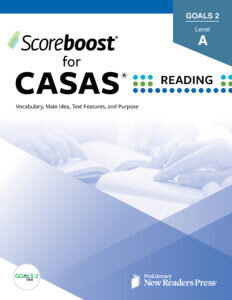 Using guidance from CASAS on the GOALS 2 updates that align with CCRS and CASAS Competencies, along with our proven instructional framework in our Scoreboost® workbooks, we are proud to announce that the first titles in our Scoreboost® for CASAS® GOALS 2 are now available.
We paid special attention to connect learning to everyday situations that are key to CASAS. Students will encounter authentic materials—paystubs, time sheets, caution signs, and more—that they will recognize from work and daily situations. Combined with practical tips and workplace connections, students will gain a deeper understanding of how academic skills are relevant to their lives.
The full reading series will be available by December, with math following by May.