
Supporting the Field We Serve with a Total of $1.8M in Grant Awards
Every adult learner brings unique goals, determination, and potential to their educational journey. Through the National Book Fund, Literacy Opportunity Fund, and Mobile Learning Fund, ProLiteracy equipped local literacy programs last year with $1.1 million in resources and tools to meet learners where they are—and help them build skills, confidence, and new possibilities for the future. We didn’t stop there. In addition to our three main grants, we supported programs with an additional $700,000 in professional development opportunities, Navigating Success support, Education Network licenses, and much more. Together, ProLiteracy grants are changing lives, one learner at a time.
Low-Budget Programs Rely on National Book Fund
As ProLiteracy’s longest running grant program, the National Book Fund (NBF) has continued to grow for over 30 years, allowing more programs than ever before to increase their capacity and serve more students.
Getting proven, research-based materials into the hands of adult learners is a necessary part of helping students make gains. Yet, for many adult literacy programs, funding to purchase enough materials can be hard to find, limiting their ability to effectively serve students.
Lake Region State College Adult Learning Center in Devils Lake, North Dakota, serves many students from rural, low-income, and Native American communities that already face barriers to education. The program needed a way to ensure it could support all students, no matter the circumstances.
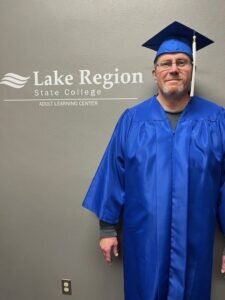
Graduate at Lake Region State College Adult Learning Center.
“Without the National Book Fund grant, our program would not have been able to purchase the high-quality, GED®-aligned textbooks needed to support our growing student population. Budget limitations would have prevented us from providing enough materials for all learners, especially those who cannot afford to buy their own resources,” shared Lloyd Halvorson, Vice President for Academic & Student Affairs.
Through the grant, the program received the GED® Test Mastery series from ProLiteracy New Readers Press, allowing for consistent, structured instruction across the program. The new materials allow instructors to create targeted assignments and reinforce key skills based on the books’ built-in assessments that identify student needs and personalize instruction.
How one adult learner benefited from NBF
For over a year, a 59-year-old adult learner had been working to earn his GED credential after being separated from education for decades. The GED mathematics test had become a significant roadblock for him, despite extra tutoring and hours of studying. When Lake Region State College Adult Learning Center received its National Book Fund materials, everything started to change.
“For the first time, he had access to clear, structured lessons written specifically for adult learners. The step-by-step explanations, practice problems, and review sections helped him understand concepts that had never clicked before. Instead of feeling overwhelmed, he began to feel grounded and supported by a resource that made math feel possible,” Halvorson said.
Over the next two months, the student worked through the book, reviewing foundational skills he had not used in over 30 years. When test day came, he felt confident. He passed after a year and a half of hard work.
“Before receiving [the new materials], he felt discouraged and unsure of what to study,” Halvorson said. “After using them, he felt equipped, capable, and motivated. The materials didn’t just help him learn math, they helped him believe he could finish something he once thought was impossible.”
Earning his GED credential has opened new job opportunities and allowed him to continue his education. He told Halvorson that it has changed the direction of his life.
“His story highlights the transformative impact the National Book Fund has on adult learners, especially those who face long-standing academic barriers,” Halvorson said. “With the right tools, support, and perseverance, he proved that it is never too late to succeed.”
Mobile Learning Fund Presents New Language in Context
At Blue Ridge Community and Technical College, in Martinsburg, West Virginia, Associate Dean of Humanities Katherine Cox said as she learned that the population of non-native English speakers was increasing in the local area, she saw the Mobile Learning Fund as a way to help meet that need.
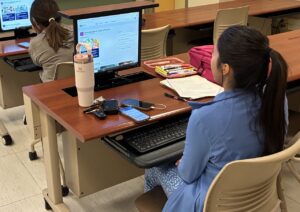
Students work on EnGen at Blue Ridge Community and Technical College.
Using the fund to obtain free licenses to EnGen, a comprehensive online learning platform that delivers workforce-aligned English instruction, the adult education program has been able to open new doors to language that helps English language learners break down cultural barriers and introduces the words they need to navigate their jobs and communities.
Because EnGen is tailored to each individual’s level and interests, Katherine said she has seen the program used successfully in a variety of ways.
A husband and wife use the program to build language that they can use in their restaurant. Another learner focuses on safety at the job site, while an au pair—working with native English-speaking children, has shared that EnGen taught her language that most instructors wouldn’t think to teach.
“Initially when I arrived in this country, I encountered a lot of problems with the children’s language because they … used different words to describe something,” the learner said. “For example, they did not say, ‘I need to go to the bathroom.’ They said, ‘I need to go potty.’ And this was one of the hardest adjustments I had to make.”
Informal language like “potty” is not often considered when teaching adults English, but EnGen considered it, and as a result, a learner is better prepared to communicate and navigate her new job in the US.
“EnGen is bridging cultural gaps and building confidence and ability to adjust to an English-speaking culture,” Katherine said.
Without the Mobile Learning Fund, Katherine said the college would likely not be able to offer a platform like EnGen in its free English language classes. The grant allows learners to access additional language learning in a context that is meaningful to them.
Literacy Opportunity Fund Puts Supplies in Students’ Hands
The Literacy Opportunity Fund is awarded to adult literacy and education programs for general operating purposes. One such program is the Rohingya Culture Center (RCC) in Chicago, Illinois, which uses its grant to support its students, who are mainly Rohingya refugees with no formal education.
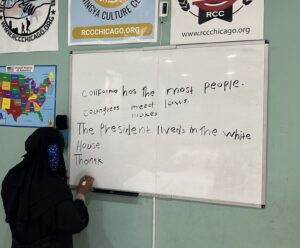
A student writes on the board at Rohingya Culture Center.
The RCC serves anyone, though the majority of its clients are Rohingya, providing them with a chance to thrive in the US by teaching English while also building basic literacy and numeracy skills that they were denied in their home country. Using the Literacy Opportunity Fund grant, the RCC can provide its adult students with backpacks, notebooks, pencils, erasers, binders, and other school supplies.
The goal is to create a welcoming environment for students without the extra expense of purchasing materials on their own or the stress of not knowing what to purchase because they have no past educational experience.
Instructor Erika Husby said the RCC buys materials because if you’ve never held a pencil before, you wouldn’t know what to buy.
When every student has the same materials, every student feels like they belong. Then, Erika can implement classroom routines that incorporate basic instruction.
“Things that we can do every day help us practice basic literacy skills, language skills, and study skills,” Erika said. “And so, I provide notebooks and I explain, ‘OK, so this is how we’re going to start the class. We’re going to write Today is Friday, October 9. I’m going to write it on the board, and you’re going to copy it in your notebook.’”
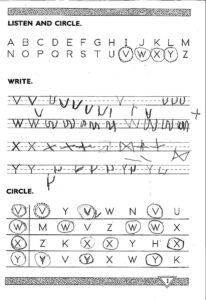
A worksheet shows student handwriting practice.
The RCC has seen its approach to instruction pay off. Adults who once couldn’t even write their names are now working toward citizenship or enrolling in college. The Literacy Opportunity Fund has made it easier to accomplish this.
“I feel like there’s a lot more [funding] opportunities for someone who’s doing ESL for nursing program or workforce or digital literacy, right? Which is great, and we absolutely need that,” Erika said. “But I think people forget that before you can be a nurse, you have to learn how to read. So, I just really appreciate when there are opportunities like [the Literacy Opportunity Fund] meeting our need.”